Contemporary Patient-Specific Approaches to the Tactics and Technique of Laparoscopic Cholecystectomy
This prospective-retrospective study demonstrates that patient-specific mathematical planning of trocar placement and instrument angles, combined with local hemostatic optimization, significantly reduces conversion rates, repositioning needs, and complications compared to conventional four-port laparoscopic cholecystectomy for acute calculous cholecystitis.
Original paper licensed under CC BY 4.0 (https://creativecommons.org/licenses/by/4.0/). This is an AI-generated explanation of the paper below. It is not written or endorsed by the authors. For technical accuracy, refer to the original paper. Read full disclaimer
Imagine you are a surgeon trying to perform a delicate operation inside a patient's belly using long, thin tools. It's a bit like trying to untangle a knot in a dark room while wearing oven mitts, but instead of a knot, you're dealing with an inflamed gallbladder. For years, surgeons have guessed where to poke holes (called "trocar" ports) in the belly wall to stick these tools in. They've relied on "eyeballing it" and experience, kind of like a chef guessing how much salt to add without a scale.
But in this study, a team from Tashkent State Medical University decided to swap the guesswork for a mathematical GPS. They asked: What if we calculate the exact perfect spots to poke holes based on the patient's specific body shape, just like a tailor making a custom suit?
The Big Experiment: Guessing vs. Calculating
The researchers looked at 214 patients who needed emergency gallbladder removals (a procedure called laparoscopic cholecystectomy). They split them into two teams:
- The "Old School" Team (128 patients): These patients got the standard treatment. Surgeons placed the tools based on general rules and their own experience.
- The "Math Wizards" Team (86 patients): These patients got the new treatment. Before the surgery even started, the team used a special computer program and a custom-made "endoscopic protractor" (a clear plastic ruler and angle-measurer) to calculate the exact angle and distance for every tool. They also used a special powder called HEMOBEN to stop bleeding, which acts like a magical, plant-based glue that turns into a gel on the wound.
The Results: Why Math Wins
The difference between the two groups was like night and day.
- The "Give Up" Rate: In the "Old School" group, the surgeons had to stop the laparoscopic surgery and switch to a big, open cut (converting to open surgery) in 33.6% of cases (43 out of 128 patients). That's more than one in three! In the "Math Wizards" group, this only happened in 9.3% of cases (8 out of 86 patients). The paper suggests that planning the angles ahead of time made the surgery so much smoother that surgeons rarely had to quit.
- Moving the Tools: In the old group, surgeons had to pull a tool out and move it to a new spot 14.1% of the time because it wasn't reaching right or was bumping into other tools. In the new group? 0%. They got it right the first time.
- Adding Extra Holes: Sometimes, the standard four holes weren't enough, and surgeons had to poke a fifth hole. This happened in 12.5% of the old group but only 7.0% of the new group.
- Bleeding and Safety: The old group had complications (like bleeding or infection) in 19.5% of cases. The new group had 0% complications. The paper notes that the new method, combined with the HEMOBEN powder, seemed to create a safer environment where bleeding stopped almost instantly (in about 2.2 minutes on average).
The Tools of the Trade
How did they do it?
- The Software: They used a program called "Laparoscopic cholecystectomy" that takes measurements like the patient's height, weight, and how deep the gallbladder sits. It then spits out the perfect angles (between 45° and 75°) and distances for the tools.
- The Protractor: They invented a clear plastic disk with a ruler and a circle of angles. It's like a giant protractor for the belly. The surgeon places it on the skin, aligns it with the target, and knows exactly where to poke.
- The Geometry: The paper explains that if you place the tools at the wrong angle, they act like crossed swords, fighting each other. If you place them at the perfect angle (around 60°), they form a "working triangle" that lets the surgeon move freely without the tools crashing into each other.
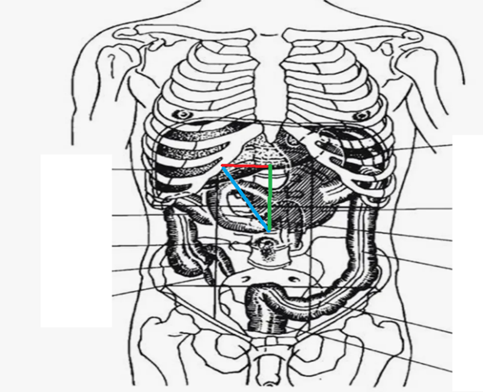
Figure 3.
What They Specifically Say Not to Do
The paper is very clear about what doesn't work well. It argues against relying solely on a surgeon's "gut feeling" or visual estimation for placing tools, especially in patients who are overweight or have severe inflammation. It explicitly states that placing tools at angles less than 45° or more than 75° creates problems: too flat, and the tools slide around; too steep, and they can't reach the target. It also notes that in the old group, the "instrument conflict" (tools bumping into each other) was a major reason for switching to open surgery.
How Sure Are They?
The authors are quite confident in their numbers because they measured them directly in a real hospital setting. They didn't just simulate this on a computer; they actually performed the surgeries on 214 real people. The results showed a statistically significant improvement (meaning the difference wasn't just luck). However, the paper frames this as a "practical, low-cost step" toward better surgery, not a magic cure-all. They acknowledge that even with the math, some cases (like severe inflammation or dense scar tissue) were still so difficult that they had to switch to open surgery.
The Takeaway
Think of this study as upgrading from a paper map to a GPS navigation system. The "Old School" surgeons were driving with a paper map, sometimes getting lost and having to turn the car around (convert to open surgery). The "Math Wizards" used a GPS that told them the exact turn-by-turn directions before they even started driving. The result? Fewer wrong turns, fewer crashes, and everyone getting home faster and safer. The paper suggests that by using simple math and a custom ruler, surgeons can make these tricky emergency surgeries much more predictable and safe, even without expensive robots.
Drowning in papers in your field?
Get daily digests of the most novel papers matching your research keywords — with technical summaries, in your language.